Welcome to the BWCAW blog of Ely Outfitting Company and Boundary Waters Guide Service!

See our websites at ElyOutfittingCompany.com and BoundaryWatersGuideService.com.

We are a Boundary Waters canoe trip outfitter, Quetico outfitter, and guide service in Ely, Minnesota. This Boundary Waters blog shares photos, stories, humor, skills, and naturalist insights from guiding in the Boundary Waters Canoe Area Wilderness (BWCAW).

Most entries are from our founder and head guide, Jason Zabokrtsky. He is the Boundary Waters Blogger.

Wednesday, June 29, 2011

Dragonflies Emerging From Fourtown Lake in the BWCAW

One of the great things about late spring and early summer in the Boundary Waters is the overwhelming sign of new life.  It seems everywhere you look there are birds on nests or with young in tow, flowers cover the forest floor, and insects such as these dragonflies are emerging to a new life of flight. 

We spotted a mass of hundreds of these dragonflies at the north end of Fourtown Lake in and around the reeds where the stream flows into the main lake.  These dragonflies spent possibly several years underwater in a nymph stage.  Then they crawled out of the water to a vertical surface - reads and blades of grass here.  Although they are difficult to positively ID at this stage, this dragonfly may be a member of the Baskettails genus that are known for mass emergences, a brown abdomen, and yellowish spots on their sides.  The below photo shows one of them back lit in the reads.  

The larval case that the above dragonfly is clinging to contained all of the much larger adult dragonfly body and wings earlier in the day.  It emerged from a break in the skin at the back of the head of the larval case, then pulled itself out, pumped blood into its wings to expand them, and waited for its wings to dry and its body to complete the metamorphosis.   

Although this dragonfly didn't take flight during our lunch stop, we watched a similar dragonfly emerge in our earlier campsite on Lake Agnes, and luckily caught a glimpse of its first flight.  The flight pattern looked erratic and dizzyingly loop-d-loop for the first twenty feet, and then it seemed to get the feel of flying and buzzed back into the woods. 

After dragonflies take flight, the empty larval shell, such as the one below, clings to the plant, rock or occasional camp utensil bag until the wind or rain knocks them loose.


Friday, June 24, 2011

Turtles are Venturing into BWCA Campsites to Lay Eggs Now

We found this snapping turtle in a BWCAW campsite on the Kawishiwi River recently.  The snapping turtles and painted turtles are venturing onto land right now to dig holes and lay their eggs.  We were surprised to see that this turtle had selected the area immediately adjacent to the campfire grate for its place to lay eggs.  The same campsite had a painted turtle digging about fifteen feet on the other side of the fire grate.  Snapping turtle eggs will hatch after two to three months.

Sunday, June 19, 2011

Father and Son Boundary Waters Canoe Trip

I spent a week in the BWCAW with Gary and his 18-year-old son, Blake, this month.  As a young Boy Scout in 1970, Gary traveled the Boundary Waters.  His youthful canoe trip experience really left a life-long impression on him.  He wanted his son to have a similar opportunity to explore the wilderness as a young man.


We planned a significant travel route for the trip - one that would challenge them physically and include travel on a variety of small, medium, and large lakes.  The trip launched at the Moose River North (Entry Point 16) landing, and ended six days, and fifty miles, later at the Mudro Lake entry point.  One of the highlights of the route is spectacular Curtain Falls (below) on the international border.

June is a glorious time to be in the Boundary Waters.  It is a time of much new growth and change.  The symbol of change is similar to that of a young man transitioning from life at home to moving away for college.

One of the intriguing things about traveling at this time of year is that you see plants at all stages of development.  Gary and Blake enjoyed learning about the various plants of the area.  Depending on soil types and locations, we saw many plants at different stages of development.  For example, we passed many Clintonia plants (below).  We saw them just poking through the ground, at a stage of larger leaves, and also with their yellowish-green flowers.  Later this summer the flower will be replaced by a blue berry.

Although the berry is not edible, the young leaves are edible and taste a lot like cucumber.  Blake is a fan of the Survivor Man television show and enjoyed learning about edible wilderness plants, and eating them.

Another one of the interesting plants we saw at various stages of growth is the sarsaparilla plant.  This is the "not poison ivy" plant.  It is often confused with poison ivy because it has three leaves at the end of its stems.  When it is young, the leaves have a reddish hue, and then they become green, and grow interesting spheres of flowers (below).


And the ferns ranged from the stage of youthful, unfurling fiddleheads to showing as fully opened.


We also saw a variety of spectacular wildflowers, including these bunchberry plants, now showing their white flowers....


...and these pink ladyslippers...


...and this columbine.


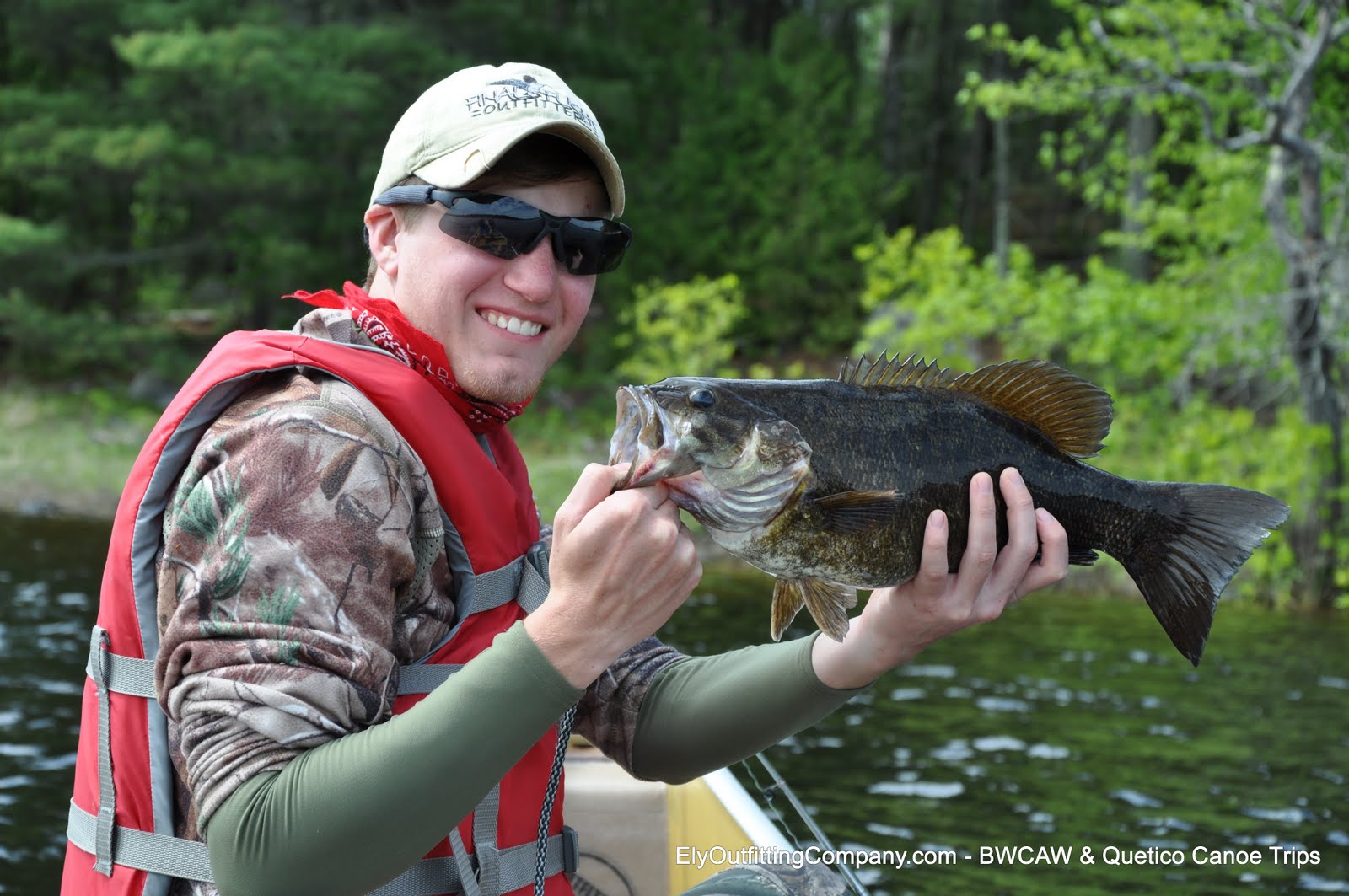
The trip involved a significant amount of portaging, and the related time for looking at the plants along the trail.  But, we also spent a significant amount of time ramping up North Woods fishing skills, and wetting lines.  Gary didn't catch a fish on the 1970 trip, and we were determined to improve on that this time around.  We did.  Blake pulled in this 18.5" lunker smallmouth bass on Iron Lake with a number 8 Rapala Shad Rap in perch color, and a trophy 27.5" walleye on Crooked Lake trolling another Rapala.


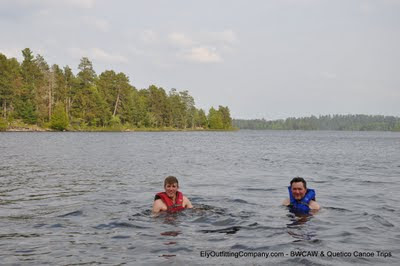
These deeper, larger lakes still held cold water temps of only about 54-55 degrees.  The shallow bays and smaller lakes held warmer temps up to about 64 degrees.  On the larger lakes, the smallmouth were deeper and not close to shore on their beds.  The cold temps made for refreshing swims. Here are Gary and Blake at the north end of Friday Bay on Crooked Lake.  The swim didn't last long.

In addition to the fish, we met some interesting critters.  For example, we watched a muskrat swim under our canoe, and Blake went toe to toe with a grouse on a portage trail.  Blake first thought the bird was going to attack him.  She was in defender mode - defending her nest of eggs laid only a few feet off the portage trail between Bullet and Moosecamp Lakes.


We also paddled past this Canada Goose laying on her eggs atop an old beaver lodge.

A trip in the Boundary Waters is a special thing for parents to share with their children.  A father-son experience, such as this one I had the privilege of guiding, can be a powerful and life-changing event.  It can develop confidence and trust in one another, and provide a platform for continued sharing.  It is certainly a life event that will be relived and retold at family events over the years to come.

Friday, June 3, 2011

"Northern Exposure" in Real Life: Moose in Ely


Many might remember television's Northern Exposure, with its wandering moose in the opening credits. Ely has its own moose, seen earlier this week walking the streets of downtown.  The yellowish sign in the background with the arched lettering is Britton's Cafe on Chapman Street in downtown.  Photo by Amy Kireta.

Friday, May 20, 2011

"Paddle North: Canoeing the Boundary Waters-Quetico Wilderness" Wins Top Honors

Congratulations to photographer Layne Kennedy and author Greg Breining.  Their new book on our beautiful region received top honors in the General Nonfiction category at the NE Minnesota Book Awards last night.

We are exceptionally pleased to sponsor a Boundary Waters Photo Workshop with photographer Layne Kennedy on August 16-21, 2011.  Space is still available.  Click here for more information. 


In addition to his award-winning photography skills, Layne is a gifted teacher, kind person, and fun companion on trail.   Point and shoot newbies to professionals learn to take better photos while immersed in our special wilderness on the Photo Workshop. 

We have copies of "Paddle North" at Ely Outfitting Company in Ely, MN.  Feel free to stop in and browse through or buy a copy.  They make great gifts for people who love the Boundary Waters.

Thursday, May 19, 2011

What lure caught lake trout in the Boundary Waters this week?

We sell only guide-recommended fishing tackle, such as this Dardevle Five of Diamonds shown above, at Ely Outfitting Company in Ely, MN.  The lakers were hanging out in the transition from deeper water to about 17 feet deep.

Monday, May 16, 2011

Early Season Solo Boundary Waters Canoe Trip


I enjoyed a five-day early May solo canoe trip this past week. The temperatures stayed pleasantly warm, even hot during the middle of the days (especially with my wool pants!). The Little Indian Sioux River flowed calmly north. After a few portages through Pawness Lakes, Shell and Little Shell, I enjoyed dinner on Lynx Lake, and portaged on over to Ruby to stay the night, arriving right at sundown.

Having seen a forecast of rain, I was pleased to find Day Two dawn sunny. On the mile-long portage from Hustler to Oyster, I spied lots of wolf traces, mostly scat. Clearly the wolves have been active up and down this trail all winter. Some people are surprised to realize that many wild animals use human trails. In fact, it's often the other way around for many paths. Animals are in the woods full-time and naturally pad around on easier paths, and so the humans traveling an area will often unknowingly track the same path kept open by deers, wolves, and moose.


I traveled past the newly-green grass along the Oyster River, and over to Agnes Lake, seeing lots of moose scat and tracks on the portage. Then it was up to Lac La Croix, where I camped across from Warrior Hill, a historical location where young native men ran to the top as a rite of passage. Clouds were moving in from the west as I went to bed.

Day Three dawned sunny again, despite the previous night's clouds and more rainy forecasts. My route took me across Iron Lake and past Curtain Falls onto Crooked Lake. The waterfall here is one of the most picturesque in the Boundary Waters, and it was brimming this spring.


The winds stayed unusually calm while I paddled along the largest part of the lake, past Sunday Bay and Saturday Bay. With the long vistas of this sizable lake, it is unusual not to see another canoe. Yet no one else was around --- I had the lake all to myself. I paddled into a head wind on Friday Bay and camped on a nice site on small Chippewa Lake.

Day Four I woke to raindrops on the tent, but fortunately the rain held off actually falling until the afternoon. On Niki Lake, before the first portage of the morning, I saw a large north-facing wall of white, which looked like a small greenhouse set up in the middle of the wilderness. It was so large, I couldn't believe it was actually icy snow. But indeed, as I got closer, I saw water running next to it, and saw it dripping as it slowly melted. I found it amazing that such a large bit of ice lasts well into the spring.


By mid-afternoon and a long portage, a fairly strong head wind had picked up, along with some precipitation. After skirting the shores, I decided not to fight it and instead waited it out at a protected spot on a campsite where I could keep an eye on the wind. I relaxed the whole evening there, and enjoyed some fresh-popped popcorn (a welcome, warm diversion on a rainy day!).

My last day, I headed out early in anticipation of wind. Several hours, and a few lakes and (challenging!) portages later, I landed on Mudro Lake and was back to my parked car before I knew it.

One of the most interesting aspects of this trip was using a SPOT (Satellite Personal Tracker). This easy little device allowed me to send an "OK" message to friends and family. It is a device without a screen and just four buttons. I simply turned it on and pressed the "OK" button, which then beamed a message with my latitude and longitude coordinates as well as my pre-recorded message to those on my contact list (and our Ely Outfitting Company Facebook page). This way, anyone could follow where I was located, and see what route I had been on so far. The SPOT offers two other two buttons for emergencies of different levels. The beauty of the SPOT is for the person in the woods, since the device is a fairly unobtrusive way to let folks know that you're ok and see where you are.

During those five days, I saw many loons, spooked many ducks and mergansers, and had a number of bald eagles watching over me. I saw a total of six other people over my five days, and according to Google earth, where my brother tracked my SPOT points, I traveled approximately 50 miles. I saw grass becoming greener and leaves as they started to bud out. For a solo trip in May, it proved to be ideal conditions in the woods.

Monday, May 2, 2011

Pussy Willows Welcome Spring Near Ely, MN

Before the snow has fully dissipated in the wetlands, a furry white harbinger of spring appears on the willow trees.  The snow-white and silver-gray pussy willows have emerged around Ely. The flowering catkins are said to have received their name from their resemblance to tiny furry pussy-cats.
I photographed these pussy willows near Ely this week.  They were later weighted down by several inches of wet heavy snow that has since dissipated.

Tuesday, April 19, 2011

900 Miles by Dogsled in the Northwest Territories


On Monday, April 11, four Minnesotan adventurers and twelve sled dogs wandered in off the ice of Great Slave Lake. Their arrival in Fort Resolution, Northwest Territories marks the end of a 900-mile trek by dogsled and ski. Dave and Amy Freeman along with Ellen Root and Van Conrad began on the banks of the Mackenzie River at Norman Wells, Northwest Territories on February 7.

While traveling through the northern wilds of Canada, they were fortunate enough to see wolves on the prowl, a herd of caribou, and wolverine. In addition to their time in the woods they stopped in various First Nations communities along their route. Their visits to Tulita, Deline, Gameti, Whati, Behchoko, and Yellowknife were filled with excitement as the expedition team gave presentations and dogsled ride at local schools.


This is the third stage of a much larger expedition. In April of 2010 the Freemans launched the North American Odyssey, a 3-year, 11,000-mile human- and dog-powered expedition, with the purpose of calling attention to North American waterways and wilderness. The expedition serves as a call to action, urging people to simplify their lives, reduce their carbon footprints, and get outside to enjoy nature. Their message has been heard by about 70,000 school children from around the globe so far.

These students are actually following the expedition team's every move through the internet. Whether they are traveling by kayak, canoe, ski, or dogsled, Dave and Amy update an education website: www.WildernessClassroom.com. This is where students, teachers and parents interact with the expedition team. A second website, www.NorthAmericanOdyssey.com, serves as a blog for adults to follow the adventure.


The odyssey will continue after the snow melts. For now, Dave and Amy are returning to the U.S. to conduct school presentations. In June they will resume canoeing south through central Danada, kayak across the Great Lakes, finishing up by following the annual whale migration down the Atlantic Coast, to the Florida Keys.

Monday, April 4, 2011

Women in the Boundary Waters Wilderness: Canoe Trips for Women and Families


You're Invited! Come hear Boundary Waters Guide Service's own Kate Ford speak at A Day For Women in Rochester, MN, at the Mayo Civic Center this Saturday, April 9. This show features all things geared toward women. And, I contend, what better activity for women and their friends and families than a Boundary Waters canoe trip?!

We will be at our booth in the Grand Lobby during the 10:00 a.m. to 4:00 p.m. show. At 1:30 p.m. Kate presents a seminar entitled Women in the Wilderness: Boundary Waters Canoe Trips for Women and Families. Women benefit so much from the Boundary Waters wilderness experience, and in this seminar, she will explain all the reasons why, debunk the reasons why not, and elucidate the how-to. Lots of pretty pictures will be shared, too!


The show is free to the public. More information and directions to the Mayo Civic Center in Rochester can be found by clicking here.

Please come on by and be sure to say hello and get more information. See you there!

Sunday, April 3, 2011

Some Bald eagles around Ely, MN, are sitting on their eggs now.

But further south, near Decorah, Iowa, a Bald Eagle pair are tending to their newborn young. Two eggs just hatched, and there is a third egg that has not hatched. See them live, on a really great web cam, right now!


Streaming .TV shows by Ustream

Wednesday, March 30, 2011

Icy Conditions Keep Us Dogsledding

Spring is on its way. We finish up the last of our dogsledding season this week. Temperatures will reach up to the 40s later this week and we will shortly see our snow disappear. But we felt lucky that these last few days have stayed cold, with overnight lows even below zero. The warmer temperatures of the last few weeks caused the snow pack on the lake to compact. This week’s cold dips turned the surface to slick ice.

With slick ice, conditions for dogsledding are fast! Amanda came with her family from Florida, and here, she enjoys driving her own team next to beautiful Blueberry Cliffs.

Sled-dog Achota pulled Amanda’s sister Elizabeth on her own sled. High 20s and full sun in the afternoon caused the icy snow under Achota’s paws to soften just enough to allow her and the other dogs to get a grip on the ice.

Spring is showing itself on the lakes in another way, as well. As the water level under the ice drops, the ice sags in the center. Along the shore, cracks start to form as the lower ice pulls apart from the ice frozen to shore. Not to worry, though. The ice is still solid enough to safely hold anyone, including an entire dog team. In fact, when cutting a hole in the ice for a sauna experience later that evening, Amanda and Elizabeth found that the lake ice was still over a foot thick.

Tuesday, March 15, 2011

Lily the Black Bear and Her Cubs Welcoming Spring Near Ely, MN


It is a sure sign of spring when our local black bears become more and more active. This video shows some wild research bears and cubs near Ely, MN, this week. The North American Bear Center is studying them in their natural environment. This den cam gives us a great look at what is happening in the woods right now.

A Job in the Woods

Here's an opportunity to work in the outdoors with young people improving the trails in Superior National Forest.  Note the job application deadline is March 20, 2011.
 
Position: Field Specialist - Trail Maintenance
Number of Positions Available: 2
Location: Ely OR Grand Marais/Tofte Minnesota
Term: April 11 – September 15, 2011
Schedule: Full-time, Temporary, flexing schedule 10 hour days typical, some weekends required  
Benefits: Stipend $1975 per month; post-service AmeriCorps education award $2675
 
The Conservation Corps provides hands-on environmental stewardship and service-learning opportunities to youth and young adults through natural resource management projects. 

More info at:  http://conservationcorps.catsone.com/careers/index.php?m=portal&a=details&jobOrderID=384925.  This photo shows a Minnesota Conservation Corps crew we saw working on trails in the BWCAW last summer.  These crews are very well trained and, in our experience, build quality trails that will last for many, many years.

Wednesday, March 9, 2011

Late-ice Crappies are Biting

It's the time of year that ice fishermen are in search of late season crappies.  We found these slabs this week suspended at about 17 feet deep.  I'm looking forward to the fish fry.