Welcome to the BWCAW blog of Ely Outfitting Company and Boundary Waters Guide Service!

See our websites at ElyOutfittingCompany.com and BoundaryWatersGuideService.com.

We are a Boundary Waters canoe trip outfitter, Quetico outfitter, and guide service in Ely, Minnesota. This Boundary Waters blog shares photos, stories, humor, skills, and naturalist insights from guiding in the Boundary Waters Canoe Area Wilderness (BWCAW).

Most entries are from our founder and head guide, Jason Zabokrtsky. He is the Boundary Waters Blogger.

Showing posts with label curtain falls. Show all posts

Sunday, June 19, 2011

Father and Son Boundary Waters Canoe Trip

I spent a week in the BWCAW with Gary and his 18-year-old son, Blake, this month.  As a young Boy Scout in 1970, Gary traveled the Boundary Waters.  His youthful canoe trip experience really left a life-long impression on him.  He wanted his son to have a similar opportunity to explore the wilderness as a young man.


We planned a significant travel route for the trip - one that would challenge them physically and include travel on a variety of small, medium, and large lakes.  The trip launched at the Moose River North (Entry Point 16) landing, and ended six days, and fifty miles, later at the Mudro Lake entry point.  One of the highlights of the route is spectacular Curtain Falls (below) on the international border.

June is a glorious time to be in the Boundary Waters.  It is a time of much new growth and change.  The symbol of change is similar to that of a young man transitioning from life at home to moving away for college.

One of the intriguing things about traveling at this time of year is that you see plants at all stages of development.  Gary and Blake enjoyed learning about the various plants of the area.  Depending on soil types and locations, we saw many plants at different stages of development.  For example, we passed many Clintonia plants (below).  We saw them just poking through the ground, at a stage of larger leaves, and also with their yellowish-green flowers.  Later this summer the flower will be replaced by a blue berry.

Although the berry is not edible, the young leaves are edible and taste a lot like cucumber.  Blake is a fan of the Survivor Man television show and enjoyed learning about edible wilderness plants, and eating them.

Another one of the interesting plants we saw at various stages of growth is the sarsaparilla plant.  This is the "not poison ivy" plant.  It is often confused with poison ivy because it has three leaves at the end of its stems.  When it is young, the leaves have a reddish hue, and then they become green, and grow interesting spheres of flowers (below).


And the ferns ranged from the stage of youthful, unfurling fiddleheads to showing as fully opened.


We also saw a variety of spectacular wildflowers, including these bunchberry plants, now showing their white flowers....


...and these pink ladyslippers...


...and this columbine.


The trip involved a significant amount of portaging, and the related time for looking at the plants along the trail.  But, we also spent a significant amount of time ramping up North Woods fishing skills, and wetting lines.  Gary didn't catch a fish on the 1970 trip, and we were determined to improve on that this time around.  We did.  Blake pulled in this 18.5" lunker smallmouth bass on Iron Lake with a number 8 Rapala Shad Rap in perch color, and a trophy 27.5" walleye on Crooked Lake trolling another Rapala.
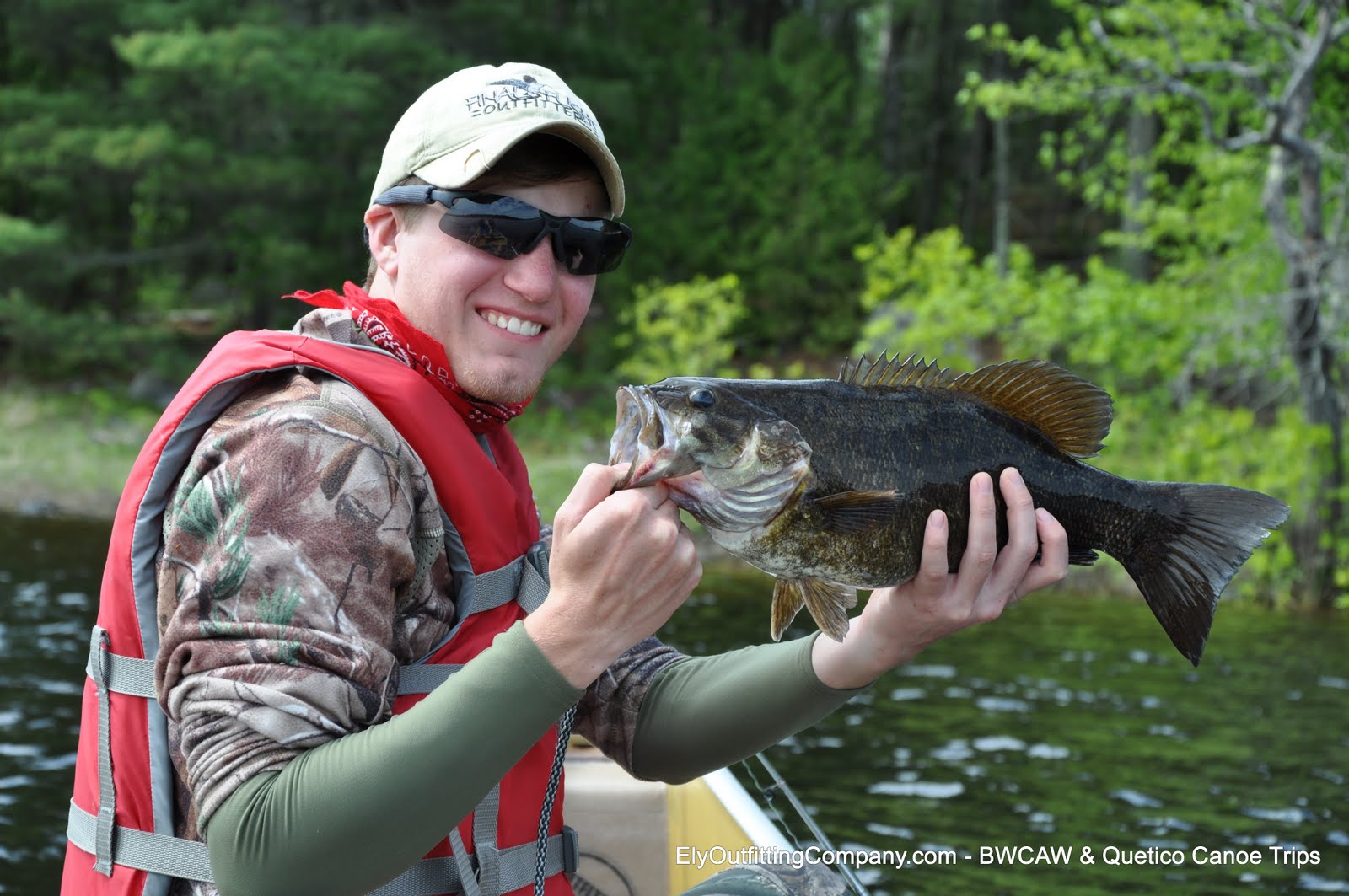

These deeper, larger lakes still held cold water temps of only about 54-55 degrees.  The shallow bays and smaller lakes held warmer temps up to about 64 degrees.  On the larger lakes, the smallmouth were deeper and not close to shore on their beds.  The cold temps made for refreshing swims. Here are Gary and Blake at the north end of Friday Bay on Crooked Lake.  The swim didn't last long.


In addition to the fish, we met some interesting critters.  For example, we watched a muskrat swim under our canoe, and Blake went toe to toe with a grouse on a portage trail.  Blake first thought the bird was going to attack him.  She was in defender mode - defending her nest of eggs laid only a few feet off the portage trail between Bullet and Moosecamp Lakes.


We also paddled past this Canada Goose laying on her eggs atop an old beaver lodge.

A trip in the Boundary Waters is a special thing for parents to share with their children.  A father-son experience, such as this one I had the privilege of guiding, can be a powerful and life-changing event.  It can develop confidence and trust in one another, and provide a platform for continued sharing.  It is certainly a life event that will be relived and retold at family events over the years to come.

Monday, May 16, 2011

Early Season Solo Boundary Waters Canoe Trip


I enjoyed a five-day early May solo canoe trip this past week. The temperatures stayed pleasantly warm, even hot during the middle of the days (especially with my wool pants!). The Little Indian Sioux River flowed calmly north. After a few portages through Pawness Lakes, Shell and Little Shell, I enjoyed dinner on Lynx Lake, and portaged on over to Ruby to stay the night, arriving right at sundown.

Having seen a forecast of rain, I was pleased to find Day Two dawn sunny. On the mile-long portage from Hustler to Oyster, I spied lots of wolf traces, mostly scat. Clearly the wolves have been active up and down this trail all winter. Some people are surprised to realize that many wild animals use human trails. In fact, it's often the other way around for many paths. Animals are in the woods full-time and naturally pad around on easier paths, and so the humans traveling an area will often unknowingly track the same path kept open by deers, wolves, and moose.


I traveled past the newly-green grass along the Oyster River, and over to Agnes Lake, seeing lots of moose scat and tracks on the portage. Then it was up to Lac La Croix, where I camped across from Warrior Hill, a historical location where young native men ran to the top as a rite of passage. Clouds were moving in from the west as I went to bed.

Day Three dawned sunny again, despite the previous night's clouds and more rainy forecasts. My route took me across Iron Lake and past Curtain Falls onto Crooked Lake. The waterfall here is one of the most picturesque in the Boundary Waters, and it was brimming this spring.


The winds stayed unusually calm while I paddled along the largest part of the lake, past Sunday Bay and Saturday Bay. With the long vistas of this sizable lake, it is unusual not to see another canoe. Yet no one else was around --- I had the lake all to myself. I paddled into a head wind on Friday Bay and camped on a nice site on small Chippewa Lake.

Day Four I woke to raindrops on the tent, but fortunately the rain held off actually falling until the afternoon. On Niki Lake, before the first portage of the morning, I saw a large north-facing wall of white, which looked like a small greenhouse set up in the middle of the wilderness. It was so large, I couldn't believe it was actually icy snow. But indeed, as I got closer, I saw water running next to it, and saw it dripping as it slowly melted. I found it amazing that such a large bit of ice lasts well into the spring.


By mid-afternoon and a long portage, a fairly strong head wind had picked up, along with some precipitation. After skirting the shores, I decided not to fight it and instead waited it out at a protected spot on a campsite where I could keep an eye on the wind. I relaxed the whole evening there, and enjoyed some fresh-popped popcorn (a welcome, warm diversion on a rainy day!).

My last day, I headed out early in anticipation of wind. Several hours, and a few lakes and (challenging!) portages later, I landed on Mudro Lake and was back to my parked car before I knew it.

One of the most interesting aspects of this trip was using a SPOT (Satellite Personal Tracker). This easy little device allowed me to send an "OK" message to friends and family. It is a device without a screen and just four buttons. I simply turned it on and pressed the "OK" button, which then beamed a message with my latitude and longitude coordinates as well as my pre-recorded message to those on my contact list (and our Ely Outfitting Company Facebook page). This way, anyone could follow where I was located, and see what route I had been on so far. The SPOT offers two other two buttons for emergencies of different levels. The beauty of the SPOT is for the person in the woods, since the device is a fairly unobtrusive way to let folks know that you're ok and see where you are.

During those five days, I saw many loons, spooked many ducks and mergansers, and had a number of bald eagles watching over me. I saw a total of six other people over my five days, and according to Google earth, where my brother tracked my SPOT points, I traveled approximately 50 miles. I saw grass becoming greener and leaves as they started to bud out. For a solo trip in May, it proved to be ideal conditions in the woods.