
Showing posts with label BWCAW. Show all posts
Showing posts with label BWCAW. Show all posts
Thursday, January 19, 2012
How Long is the Little Gabbro Lake (BWCAW Entry Point 33) Portage?
View Larger Map
Depending on who manufactured the maps you're looking at, you may find the Little Gabbro Lake portage listed as 104 rods, 200 rods, or 290 rods. It's the only BWCAW portage I'm aware of that has such wildly different lengths listed on different maps. It's not unusual for the same portage to be listed with slightly different lengths depending on the map manufacturer, but this one is exceptional.
One of the reasons for this difference is probably that the portage was re-routed at some point. Which reminds me of when I was paddling the narrows between Little Gabbro and Gabbro Lakes and a perplexed canoeist paddled up for directions. He had been searching unsuccessfully for the portage. The reason for the confusion is that his map had the portaged mis-marked by a long distance. And because the portage landing was near a designated campsite, he felt that it was just the landing for the campsite rather than the actual portage. He appreciated me marking the correct location for the portage.
I've portaged this route many times, and had a guess on the actual length. But, we decided to put the issue to rest and hiked the portage with a GPS unit this week. The above map shows our track from the entry point sign to the lake.
Based on our GPS, the Little Gabbro Lake (BWCAW Entry Point 33) portage is 208 rods. A rod is 16.5', so this translates to .65 miles. As portages go, this is a relatively easy one. It's an old logging road with a good gravel base over much of the distance. It includes rolling hills and a total elevation change of about 24 feet. The hike took us about 16 minutes one way. The lake landing is a great sandy gravel beach at average and higher water levels. At low water levels, it is boot-sucking mud. To avoid the mud, resist the temptation to pull your canoe up at the obvious landing at the trailhead. Instead, go north along the shore toward the nearby campsite, and use the firmer landing there. You will get home with both of your shoes that way.
At Ely Outfitting Company and Boundary Waters Guide Service, we do our best to outfit our guests with the best information for a successful Boundary Waters canoe trip. At our shop in Ely, you'll find our massive write-on map wall covered with specific tips and fresh info for your route. We also sell all of the specialized navigation maps for your Boundary Waters trip. We'll even remind you of the actual length of the Little Gabbro Lake portage.


Saturday, November 19, 2011
USFS Ends Lottery System for Most BWCAW Permits
Summer BWCAW canoe camping trips still require quota entry permits, but the Forest Service has changed the way early planners apply for those permits.
For years, early planners applied for permits during a Dec. 1 to Jan. 15 "lottery" period. In the lottery, you selected a desired entry point and date. At the end of the lottery period, you received your desired permit, unless there were more applications for that day/entry point than available permits, and a random drawing selected the other applicants over you. In the event you didn't obtain your first permit choice, then you would have the same chance to receive the second or third date/entry point preferences you made in your lottery application.
In reality, something over 95% of overnight paddle permit applicants in the lottery received their first permit choice.
What this change means for you: If you are planning a summer 2012 BWCA canoe trip, you want the best selection of summer camping entry permits, and you are an early planner, then you should apply for your entry permit when quota permits become available at 9 AM on January 25, 2012.
No worries, though, for folks who can't plan that far ahead. Plenty of permits are still available through spring. However, for the best selection of permits for the entry point and date that best fits your interests, we suggest you reserve your permit as soon as you decide to take a Boundary Waters trip. At Ely Outfitting Company and Boundary Waters Guide Service, we're happy to talk you through options and make some routing suggestions that are perfectly suited for your particular interests and expectations. We can also make your permit reservation for you. Feel free to call us at 218-343-7951.
We received the following official notice of the lottery changes by email from the USFS:
Jim Sanders, Forest Supervisor for the Superior National Forest has decided to implement changes to the lottery and reservation system for the Boundary Waters Canoe Area Wilderness (BWCAW).
For 2012, the lottery will be retained for Fall Lake entry points D (Fall Lake & Beyond) and 24 (Fall Lake) and Moose Lake entry points F (Moose-Newfound-Sucker), G (Moose-Prairie-Basswood) and 25 (Moose Lake). People wanting day use motor, overnight motor, and overnight paddle permits for these entry points can continue to use the lottery to make their reservations as they have in the past. All other entry point reservations will be made on a first-come, first-served basis shortly after the lottery is run.
Lottery applications can be made starting from 12:01 am CT on December 19, 2011 to 11:59 pm CT on January 19, 2012. The lottery will run on January 20th. Reservations for all entry points can be made on a first-come, first-served basis starting January 25th at 9:00 am central time. Reservations can be made at www.recreation.gov or by calling 1-877-444-6777.
For years, early planners applied for permits during a Dec. 1 to Jan. 15 "lottery" period. In the lottery, you selected a desired entry point and date. At the end of the lottery period, you received your desired permit, unless there were more applications for that day/entry point than available permits, and a random drawing selected the other applicants over you. In the event you didn't obtain your first permit choice, then you would have the same chance to receive the second or third date/entry point preferences you made in your lottery application.
In reality, something over 95% of overnight paddle permit applicants in the lottery received their first permit choice.
What this change means for you: If you are planning a summer 2012 BWCA canoe trip, you want the best selection of summer camping entry permits, and you are an early planner, then you should apply for your entry permit when quota permits become available at 9 AM on January 25, 2012.
No worries, though, for folks who can't plan that far ahead. Plenty of permits are still available through spring. However, for the best selection of permits for the entry point and date that best fits your interests, we suggest you reserve your permit as soon as you decide to take a Boundary Waters trip. At Ely Outfitting Company and Boundary Waters Guide Service, we're happy to talk you through options and make some routing suggestions that are perfectly suited for your particular interests and expectations. We can also make your permit reservation for you. Feel free to call us at 218-343-7951.
We received the following official notice of the lottery changes by email from the USFS:
Jim Sanders, Forest Supervisor for the Superior National Forest has decided to implement changes to the lottery and reservation system for the Boundary Waters Canoe Area Wilderness (BWCAW).
For 2012, the lottery will be retained for Fall Lake entry points D (Fall Lake & Beyond) and 24 (Fall Lake) and Moose Lake entry points F (Moose-Newfound-Sucker), G (Moose-Prairie-Basswood) and 25 (Moose Lake). People wanting day use motor, overnight motor, and overnight paddle permits for these entry points can continue to use the lottery to make their reservations as they have in the past. All other entry point reservations will be made on a first-come, first-served basis shortly after the lottery is run.
Lottery applications can be made starting from 12:01 am CT on December 19, 2011 to 11:59 pm CT on January 19, 2012. The lottery will run on January 20th. Reservations for all entry points can be made on a first-come, first-served basis starting January 25th at 9:00 am central time. Reservations can be made at www.recreation.gov or by calling 1-877-444-6777.
Friday, May 20, 2011
"Paddle North: Canoeing the Boundary Waters-Quetico Wilderness" Wins Top Honors
Congratulations to photographer Layne Kennedy and author Greg Breining. Their new book on our beautiful region received top honors in the General Nonfiction category at the NE Minnesota Book Awards last night.
We are exceptionally pleased to sponsor a Boundary Waters Photo Workshop with photographer Layne Kennedy on August 16-21, 2011. Space is still available. Click here for more information.

In addition to his award-winning photography skills, Layne is a gifted teacher, kind person, and fun companion on trail. Point and shoot newbies to professionals learn to take better photos while immersed in our special wilderness on the Photo Workshop.
We have copies of "Paddle North" at Ely Outfitting Company in Ely, MN. Feel free to stop in and browse through or buy a copy. They make great gifts for people who love the Boundary Waters.
We are exceptionally pleased to sponsor a Boundary Waters Photo Workshop with photographer Layne Kennedy on August 16-21, 2011. Space is still available. Click here for more information.

In addition to his award-winning photography skills, Layne is a gifted teacher, kind person, and fun companion on trail. Point and shoot newbies to professionals learn to take better photos while immersed in our special wilderness on the Photo Workshop.
We have copies of "Paddle North" at Ely Outfitting Company in Ely, MN. Feel free to stop in and browse through or buy a copy. They make great gifts for people who love the Boundary Waters.
Thursday, May 19, 2011
What lure caught lake trout in the Boundary Waters this week?

Wednesday, March 9, 2011
Late-ice Crappies are Biting

Monday, February 28, 2011
New Phone Number and New Rates: Two of Several Changes in the BWCAW Reservation System
NEWS RELEASE
US Forest Service
Superior National Forest
US Forest Service
Superior National Forest
Duluth, MN - As part of our ongoing service to the public, managers on the Superior National Forest have been working with a contractor over the past few years on several changes to increase efficiency of the wilderness permit reservation system.One of the outcomes is a reduction in the reservation fee charged by the contractor to process Boundary Waters Canoe Area Wilderness (BWCAW) permits. Effective March 1, 2011, the fee to reserve a BWCAW permit will drop from $12.00 to $6.00.
The reservation fee is separate from the user fee. User fees are utilized by the Forest Service for improving and maintaining portages and campsites in the Wilderness as well as for educational activities. There is no change in the BWCAW user fee.
Some of the changes that contribute to a more stream-lined service include:
Merging the BWCAW reservation service with the National Recreation Reservation System, which is the one-stop on-line reservation service for all federal lands in the United States.
Reduced paper work by eliminating requirements for printing, mailing and carbon copies.
Increased efficiency in operating the annual BWCAW permit lottery. For example: It now takes about 30 minutes to run, versus an entire day previously, and confirmation letters are emailed instantly.
Ability of Forest Service staff to now enter information directly into the system rather than involve contract staff.
Eliminated “no pays” equaling thousands of dollars each season through instant credit card processing.
Cooperator access to issue walk-up permits (formerly “quick permits”) via computer.
Customer ability to cancel reservations on-line, change group size, and make payments prior to permit pick-up.
Another change merged the BWCAW call center and customer service numbers into the centralized National Recreation Reservation System number. This actually extended the hours of operation significantly.
National Recreation Reservation Service: 877- 444-6777
March 1 to October 31, from 9:00 am to 11:00 pm, Central time
November 1 to February 28, from 9:00 am to 9:00 pm, Central time
March 1 to October 31, from 9:00 am to 11:00 pm, Central time
November 1 to February 28, from 9:00 am to 9:00 pm, Central time
Sunday, November 14, 2010
Winter's Arrival in Ely
 Last week's spring-like weather has given way to winter. Yesterday it started snowing and today, we woke up to about four inches of the fluffy white stuff. We have buttoned up all of our summer gear and are getting ready for another Northwoods winter. Bring on the dog sleds!
Wednesday, October 13, 2010
Women in the BWCA Wilderness
 I recently guided two all-women's camping trips. What a blast! Both groups of talented, smart and go-get-em women sought out a female guide for their Boundary Waters camping experience.
I have guided canoe trips over ten summers for teenage and adult women in the Boundary Waters Canoe Area Wilderness and Quetico Provincial Park, working at the Northern Lakes Girl Scout Canoe Base and here at Boundary Waters Guide Service. I have become a believer in the truly different and remarkable experience that is possible with a group of only women.
 I haven't seen the statistics for travel by men versus women, but what I have noticed personally is that there are substantially more men traveling in this wilderness area. By far, the majority of groups are exclusively men, with a fair amount of groups with one or two women. This reality underscores just how unique an all-women's trip is in the Boundary Waters.
As much as I tried to deny it when I first started guiding canoe trips in the Great North Woods, women really don't have the muscle mass that men do. The canoe that men (of many ages) can pick up without any technique does not go on my shoulders without teamwork or some real practice. That applies big-time to groups of first-time women to the Boundary Waters. Teamwork really becomes key.
During an orientation before getting out on the water, we tackled portaging technique, which is typically the most intimidating aspect of a BWCAW trip. Each group learned how to use three people to flip the canoe upside-down, and then each person took a turn carrying the lightweight Kevlar canoe. The task was surprisingly conquerable to most, even a breeze to a couple of the stronger women!
 After our first few hours of paddling, everyone discovered, despite their trepidation, that the portaging was actually quite do-able, though still a workout. Both groups of women smiled with accomplishment (and maybe a little tiredness) at the end of their first long portages. Everyone was definitely appreciative a little while later of a campsite where we could rest and relax.
The eight ladies of the first group were friends since having their children involved together in Girl Scouts or Boy Scouts, and boy, were they a get-er-done kind of group. They gathered armloads of firewood, found time to relax, and shared much laughter. Some felt a little nervous about the physicality of a canoe trip, others just looked forward to relaxing and not having to cook. These ladies were all made for this kind of canoeing adventure, amusingly calling themselves "Kate Plus Eight."
 My second group of ladies, four this time, were nurses or nurse practitioners with numerous stories about the many babies they had delivered. Lovely women with great stories, also quick learners and very capable in a canoe in the gusty conditions we experienced. These four ladies had worked together in their profession for years and were absolutely great at working with each other in this new environment.
 These two trips in the late summer season had lovely weather -- highs up toward 70 degrees and low temps in the 40s, sometimes dipping down to the 30s. Since women typically tend to feel colder, I used another trick for our ladies: we filled everyone's water bottle with hot water overnight to keep our sleeping bags toasty warm. It proved to be a delightful surprise.
 It seems to be true no matter the woman's age: after experiencing an all-female canoe camping trip, there is a definite sense of empowerment. I believe these already intelligent and accomplished women were no exception. Being "out there" for three or four days and relying only on each other for forward movement tends to build trust, make a lot of fun moments, and create an experience that will not be quickly forgotten.
Wednesday, July 28, 2010
Cedar Waxwings and Pin Cherries

Summer is a busy time for Cedar Waxwings here in northern Minnesota. Much of the summer, you will find these birds on their perfect perch waiting for dinner to pass by. When the 7-inch bird spies its scrumptious meal of mosquitoes or moths, it swoops down, snatches the bugs up, and returns to the same perch to await more unaware passersby. These birds typically eat the abundant bugs of summer, but come mid-July, tasty berries lure them away from their carnivorous ways.
 We found these Cedar Waxwings enjoying quite a meal in the BWCAW from the relatively small (not more than 20 feet high or so), smooth-barked Pin Cherry tree. The Pin Cherries ripen in mid- to late-July, and are bright red and partially translucent with a large pit in the middle. Fortunately for the birds, who are wild about the cherries, the fruit is very sour to our human taste buds. It takes a lot of sugar to make the Pin Cherry taste decent!
While a lot of fruits fall to the ground during the tree's short lifetime of 25-30 years, you won't find this tree all over the forest. It needs plenty of sun. Often the pits of the Pin Cherries fall in the shade of the tree itself where they can't immediately germinate. Fortunately, the pit has a waterproof coating which prevents the seed from rotting, even as long as fifty years or more! When a disturbance eventually happens, like a strong windfall or forest fire, sunlight fills the ground and the seeds germinate en masse. Soon after, there will be a solid stand of even-aged Pin Cherry trees. The trees that we found were in a very sunny spot on the top of a high hill overlooking one of the many beautiful lakes of the Boundary Waters.

There was one other little guest hiding in the tree. This chipmunk was perched a few feet up in the tree enjoying his own snack of Pin Cherries!
Saturday, July 17, 2010
Underwater Photography in the BWCA

Some people embrace the water and bring along waterproof cameras. They definitely take some of the stress out of the possibility of dunking an expensive camera. Kate is carrying a waterproof camera this summer and she really likes that she can keep it at hand rather than packed away in a cumbersome case. She shot this photo by holding her camera under water and pointing it toward the sky. My favorite part of this perspective is that you can see the air bubbles on the underside of the lilly pads!
Kate is using an Olympus waterproof shockproof camera and she likes it.
If you're interested in photography and want to improve your skills while immersed in the BWCAW, consider participating in our Boundary Waters Photo Workshop led by professional magazine and nature photographer Layne Kennedy. More info on our BWCA Photo Workshop is at this link: http://boundarywatersguideservice.com/PhotoWorkshop.html. Most folks bring cameras that are not waterproof on photo workshops, and we take special care to make sure they return safely.
Friday, July 9, 2010
Fly Amanita - Storybook Mushroom in the BWCAW

Fly Amanita is the quintessential toadstool we started drawing as kids in elementary school. It's also known as the "fly mushroom" or "fly poison mushroom" because it is believed a saucer containing Fly Amanita in milk will attract and kill flies.
The young mushroom begins covered in a universal veil and may be misidentified as a Puffball mushroom. As the mushroom grows, the veil breaks apart and its remnants are seen as whitish "scabs" on a bulbous cap. As it continues to mature, the bulbous cap becomes more flat and the white gills are visible on the underside of the cap. When the mushroom reaches maturity, the outer edges of the cap may cup upward.

The Fly Amanita is indigenous to northern Minnesota. It is usually yellow-orange here - in contrast to bright red varieties elsewhere. The cap size ranges from 3 to 10 inches wide, and the white stem grows 3 to 7 inches tall.
They are found growing from the ground - not from trees - from June through September. They are typically found among stands of pines and aspens.
The toxins muscimol and ibotonic acid are contained in Fly Amanita. Ingestion can cause serious internal injury and, in some rare instances, death. They are generally considered poisonous and not edible. However, some report that the toxins may be parboiled out of the fungus, and rumors surround the hallucinogenic effects caused by people eating these dangerous mushrooms. Lore has it that the Vikings of the eleventh and twelfth centuries ingested them and found superhuman strength. And Lewis Carroll, author of Alice in Wonderland, was a known experimenter with drugs. His book illustrations included a white-spotted red mushroom appearing to be Fly Amanita. Another side effect of ingesting Fly Amanita is macropsia - a condition making things appear larger than life size. Sounds like the book, doesn't it.

I snapped these photos recently on a portage along the Little Isabella River in the BWCAW. During the canoe trip, deer flies buzzed around our heads. It makes me wonder: Might Fly Amanita in a milk concoction work for meddlesome deer flies around camp?
Wednesday, June 23, 2010
Sulfide Mining on the Edge of the BWCAW

Border Lakes Outfitting and Jason Zabokrtsky teamed with the Friends of the Boundary Waters recently to raise awareness for the potential environmental impacts of proposed sulfide mining operations on the edge of the Boundary Waters. Jason guided the group of environmental advocates and media representatives, including Stephanie Hemphill of Minnesota Public Radio and John Myers of the Duluth News Tribune.
See the Duluth News Tribune Article here. Listen to the MPR story here, or see the full text below.
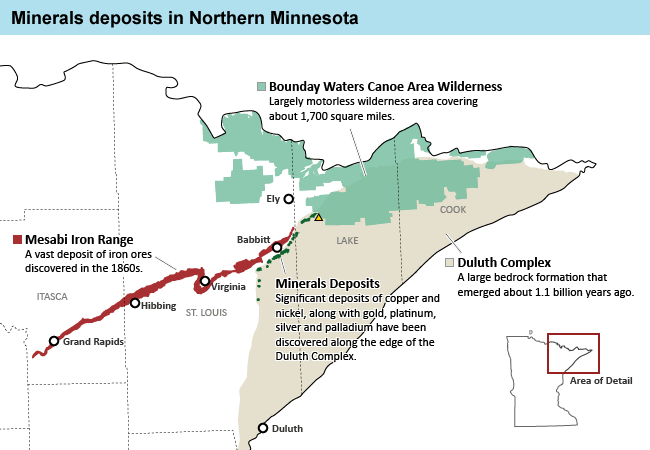
Ely, Minn. — Six mining companies are doing exploration work that could lead to mines near the Boundary Waters Canoe Area Wilderness, and that's got a lot of people concerned.
The companies are drilling deep holes, probing huge deposits of valuable copper, nickel, gold, platinum, and palladium.
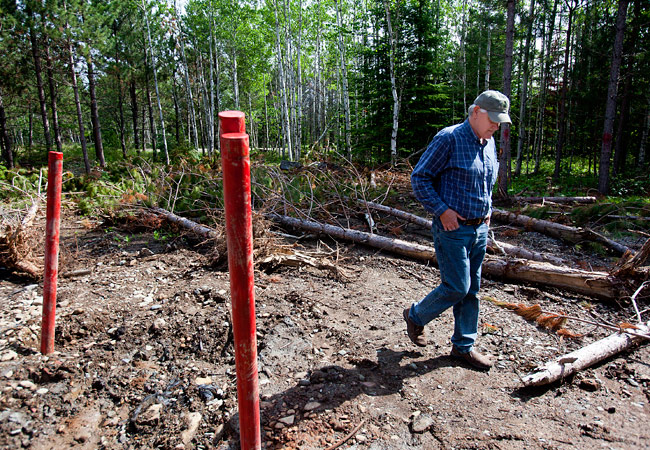
Steve Koschak looks at a drill site near his River Point Resort on the South Kawishiwi River just east of Ely, Minn.
"This goes 24-7," he says of the constant drone of a drilling rig.
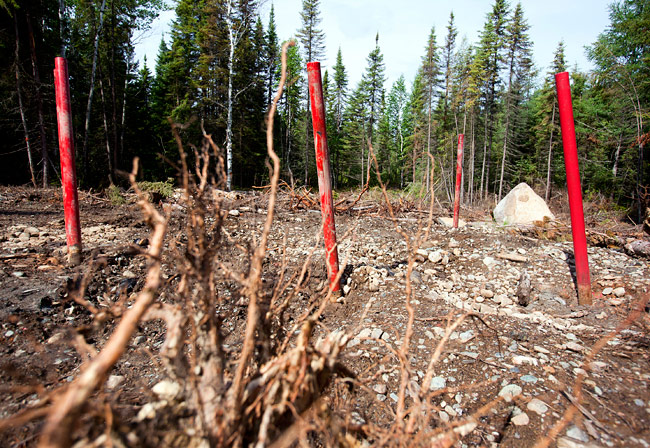
A contractor for Ely-based Duluth Metals is drilling a six-inch hole, about 3,000 feet into the earth. A trickle of water runs to a pit a few feet away. The pit holds water and a scum of gray muck, finely ground rock from deep in the earth.
"If you were to analyze all that, there's probably copper-nickel in that. But look what it's going into, it's going into the swamp," he says. "That's all this is, is a network of spruce swamps, all interconnected, this all goes into Birch Lake, all this water."
When the drilling is done, workers will bury the muck on site, a state requirement. The trouble is, around here there are so many wetlands, it would seem impossible to keep the muck out of the water system. Duluth Metals officials say there won't be enough mineral waste here to be any cause for concern.
This drilling is a precursor to what could be a deep shaft mine, more than half-mile below the surface of the earth. A mine would produce tons and tons of ground-up waste rock.
And this is sulfide rock. When it's brought to the surface, a chemical reaction occurs that produces sulfuric acid. If the rock is not carefully isolated from air and water, it can acidify nearby streams and wetlands -- possibly enough to poison the life in the water.
In many mines, discharges also contain traces of heavy metals such as lead, arsenic and manganese. The problem is called acid mine drainage, and it's happened wherever copper mines have been drilled.
The advocacy group Friends of the Boundary Waters Wilderness has organized a canoe trip for reporters to show how close the mining operations are to the Boundary Waters wilderness. We put in at entry point 32 on the South Kawishiwi River.
We pass turtles sunning themselves on rocks, and a pair of mergansers keeping a close eye on their young brood.
"This is where all the mining exploration's going on, just to the east of the river," says our guide, Jason Zabokrtsky. He points out that the drilling is going on about three miles south of the edge of the Boundary Waters. But here the river turns north and then flows into the heart of the wilderness.
"Into Fall Lake, then into Newton and Basswood Lake, across to upper and lower Basswood Falls, into Crooked Lake, into Iron Lake, across Curtain Falls, and into Lac la Croix," he says. "All really well-known Boundary Waters lakes."
Some people who live near the potential mining sites are worried. Bob Tammen, who lives in Soudan, about 20 miles from Ely, and has vacation property on the South Kawishiwi River, says he doesn't trust the state to protect the environment. The state, he said, hasn't been able to completely clean up pollution from the Dunka pit, a waste site from a taconite operation that accidentally exposed sulfide rock 50 years ago, and ever since has been leaching metals into a nearby creek.
"We've been trying for 30 years to get the Dunka site cleaned up. My contention is, if the state of Minnesota, working with the mining industry, can't clean up a mining site in 30 years, why should we ever grant a permit for a copper mining operation?" Tammen says. "We know that copper is generally in sulfide ore bodies, whereas our iron mining industry is generally in oxide ore bodies, which is not as damaging as sulfide. They haven't been able to manage the iron mining industry; we should not, at this time, trust them to permit a copper mining industry."
State officials say the Dunka problem happened before rigorous rules were imposed on mining operations.
The Minnesota Pollution Control Agency's Ann Foss says it's difficult to solve an unexpected problem, but the experience at Dunka has taught the agency a lot about how sulfide rock reacts when exposed to air and water. She says that experience will help inform environmental reviews of any sulfide mining proposals.
The Friends of the Boundary Waters has backed legislation at the state level to beef up requirements on financial assurance -- similar to the escrow fund that BP has agreed to set aside for the ongoing oil spill in the Gulf of Mexico. Last year, the Minnesota measure died in committee.
Some of the neighbors here, around the edge of the Boundary Waters want to go further: they want the state to prohibit sulfide mining unless a company can point to one place in the world where a mine has operated without polluting water. Since a similar law passed in Wisconsin, no mines have been built in the state.
The exploration is happening on the southwest edge of the Boundary Waters. Fifteen miles to the west is the town of Ely.
There are varying opinions in Ely on the exploration and possible mine development. The area has long been dependent on jobs in mining, logging, and tourism. Some people are excited about a new source of good-paying jobs. They still remember when the underground mine in Soudan used to ship tons of rich, iron ore. It closed in 1962 and now is a state park.
Duluth Metals has an office in Ely, in a house on a quiet street. The walls are covered with colorful geologic maps, and in an attached garage there are lots of core samples from those drill sites down the road.
David Oliver, the project's manager, is very excited about the minerals that lie more than a half-mile beneath the surface, on 1,500 acres near the South Kawishiwi River.
"We have now drilled 170-some drill holes that verify a resource in excess of 900 million tons that was never on the books before," Oliver said.
He says a mine tapping into that resource could employ 400 people for decades to come.
Copper and nickel, and the associated precious metals, are used in everything from electric wires and computers, to catalytic converters and rechargeable batteries, so demand is going up all the time.
The combination of higher prices and improved technologies to recover the minerals is generating new excitement about a deposit that geologists have known about for a long time. Oliver discounts worries about polluted groundwater. He says the core samples are solid, nearly free of cracks, so it wouldn't be easy for any polluted groundwater to travel through this ancient rock.
And, he says, the waste rock will contain so little sulfur that the kind of pollution that has occurred at other mines is unlikely.
"This is deemed below any threshold that would generate acid drainage," Oliver says. "It just doesn't have enough sulfur to do it."
Until recently, a different company -- Polymet -- was the front-runner in the race for copper-nickel in Minnesota.
Polymet's property is just south of the land Duluth Metals is exploring. The Minnesota DNR and the U.S. Army Corps of Engineers did a draft Environmental Impact Statement for the Polymet project, but the federal Environmental Protection Agency did a scathing review of the work, saying it was inadequate. It will take more than a year to re-do it.
Meanwhile, Duluth Metals' new partnership with Antofagasta, a Chilean company, provides enough money to move that project ahead quickly. David Oliver says Duluth Metals should be ready for environmental review in about three years.
Sunday, June 13, 2010
Ely, MN - The Coolest Small Town in America

Ely, MINN - National travel magazine Arthur Frommer’s Budget Travel has named Ely, Minn. as its 2010 “Coolest Small Town in America.” The magazine received 147 nominations, then selected 21 American towns that stood out from the crowd to open up to public online voting. In online voting, 439,411 votes were received, and Ely captured 118,899 of those—27 percent of all votes.
A feature on the city of Ely will be included in the magazine’s September 2010 issue.
Ely is located in the Boundary Waters region, on the US-Canada border between Ontario and Minnesota, and is a popular destination for campers, as well as canoe and fishing enthusiasts, and those looking for natural scenery and relaxation.
The magazine defined what they sought for 'Coolest Small Town' as a town with a population under 10,000. According to the original solicitation for nominations, the magazine wrote, “we're talking small towns, not big cities. It's also got to be on the upswing, a place that's beginning to draw attention—and new residents—because of the quality of life, arts and restaurant scene, or proximity to nature. And cool doesn't mean quaint. We want towns with an edge, so think avant-garde galleries, not country stores.” The runner-up cities were Cloverdale, Calif. and Brevard, N.C.
See the original competition details here: http://www.budgettravel.com/
“People have long recognized that Ely’s a town full of eccentric people and interesting cultural offerings, but also a land of beautiful wilderness,” says Linda Fryer, director, Ely Chamber of Commerce. “We may be at the end of the road, but once you get here, there’s a lot to see and do.”
The magazine summarized Ely in an introductory article in January: “Also called the End of the Road, Ely sits in Minnesota's scenic extreme north, where it once served as an iron-mining hub. But Ely has come a long way since her unglamorous mining days, now playing host to a number of renowned wilderness facilities like the International Wolf Center and the North American Bear Center. The city is a perfect base for camping, canoeing, and fishing, as the nearby Boundary Waters Canoe Area Wilderness offers an untouched expanse of lakes and bogs straddling the U.S.-Canadian border. Ely has become notorious for the annual April Fools’ jokes that city leaders play on the eager-to-be-fooled citizens. In 2008, a press release announced that Ely was being sold to Canada to boost tourism. The mayor commented on the subject in a local newspaper, and cheeky ‘Say No to Canada’ signs were displayed along the highway. The following year, Ely began a mock-campaign to secure the right to host the 2016 Olympic Games.”
In 2010, Ely once again engaged in April Foolery with an announcement on April First that it, in conjunction with the Forest Service, had signed a multi-year deal with a nationally known corporation for naming rights to the legendary Boundary Waters Canoe Area Wilderness (BWCAW).
Arthur Frommer's Budget Travel magazine is published monthly except for combined issues in December/January and July/August by Intellitravel Media, Inc. BudgetTravel.com is the website for Budget Travel magazine, which receives approximately 1.8 million unique page views per month.
For more information on Ely, Minn., and to book a Boundary Waters canoe trip vacation that’s less than four hours from the Twin Cities, please visit www.BorderLakesOutfitting or call 218-343-7951.
Tuesday, June 8, 2010
Common Merganser and Ducklings on Lake One in the BWCAW

We paddled to a quiet bay away from the main travel route to look for wildlife on a guided day canoe trip today on Lake One.
Luckily, we spied this Common Merganser and her ducklings. The young were probably born in a hollow tree - where Mergansers typically nest. The mother must have just recently nudged the furball ducklings out of the nest because they are still tiny creatures. Part of me expected to see a giant pike splash out of the water after one of them.
We saw no sign of the male merganser, which is not uncommon. Motherhood is a lonely job for these females. The males typically play no part in raising the ducklings.
We watched this Common Merganser dive down looking for minnows to catch in its orange serrated bill - often called a sawbill. It didn't appear to succeed in hunting minnows, but it did successfully pluck a dragonfly nymph from a rock wall as it swam by.

Sunday, May 23, 2010
Young Fern Fronds Unfurling in the BWCAW

Summer is on its way! The leaves are exploding out everywhere, and closer to the ground, the ferns are coming out in their own way. The tightly-curled immature fern fronds are called fiddleheads. As a fiddle player myself, I can verify that they do indeed resemble the top of my instrument. It only takes a few days for the young ferns to unfurl, so it is a fun discovery to spy these young plants before they have their big flat leaves of the summer. We found these on a day trip this week into the BWCAW, on the Isabella River.
Bracken ferns are an abundant plant in the BWCAW. Some people say that bracken ferns are good mosquito repellent. Just take one full-sized leaf and set atop your head or stick in your hat, and see what you think.

Entry and photos by Wilderness Guide Kate Ford
Saturday, May 1, 2010
A Canoe Trailer That Will Last
 We picked up a new canoe trailer today at Remackel Welding in Forest Lake, MN.
Around Ely, canoe trailers bounce down some pretty rugged roads. Names like “Echo Trail” and “Tomahawk Trail” reflect the rustic nature of the routes here. These roads and harsh northern elements put canoe trailers to the test.
Meet one of the most durable canoe trailers available. This photo shows our six-place canoe trailer with box by Remackel Welding. As we talked with other outfitters about canoe trailers that last the longest under heavy use, we repeatedly heard about the custom trailers by Dennis Remackel. He’s been making them by hand for several decades.
Dennis gives people several options to customize their trailers. Rust is the nemesis of a trailer, so we chose to have the trailer hot-dip galvanized. Once welded together, the trailer is dipped in molten zinc resulting in a trailer that won’t rust and never needs painted. The cool-factor is pretty high, and the practical durability factor is even higher.
If you take lots of canoe trips and want to tow your own canoes, then you may want to consider one of Remackel's four-place canoe trailers with a large box and optional box cover. See photos on the Remackel website.
Shown in front of the new trailer are Dennis Remackel and Kate Ford.
Monday, April 5, 2010
March BWCAW Canoe Trip
 It's almost never possible to do a Boundary Waters canoe trip in March. But, with our early spring, and summer-like temps, I eagerly watched the forecast in hopes of just such a March trip. Sure enough, the rivers freed up from ice quickly and even some of the lakes were going out by the end of the month.
One of the joys of life in the Northwoods is that we can take advantage of the lovely weather that arrives at unexpected times. It would seem pretty unreasonable to actually plan a March canoe trip here. But, with good weather and warm temps forecast, I charged out on March 31 for an overnight BWCAW canoe trip up the Little Indian Sioux River. The planned route took me south on the Little Indian Sioux, past Sioux Falls (shown in the photo), up the Little Pony River, through Bootleg Lake, then out the south end of Bootleg and back north on the Little Indian Sioux.
 As I paddled toward Bootleg, my curiosity about whether it would be open or locked in ice yet grew. Fortunately, the typically low (and sometimes virtually impassable) Little Pony River had adequate water, and I portaged into Bootleg at about 6 PM. A stroke of luck meant the lake had opened up and was virtually ice-free except for some candle ice that collected near the portage. Lexee-dog seemed intrigued by the sound of the ice chinkling against my paddle and the canoe.
 What a remarkable trip. With two days of t-shirt weather I observed a bonanza of wildlife celebrating the advent of spring. I saw all sorts of firsts for the 2010 ice-out season: beavers slapping their tails, muskrats, minnows, a leech, mosquitoes (two!), a fish jumping, mallards, a herring gull, Canada geese flying north, maybe an osprey in the distance, and some other ducks.
But the wildlife highlight of the trip occurred within about a mile of the takeout. As I rounded a bend, I spied two trumpeter swans leisurely preening themselves on the river. They let me relax and watch them swim gracefully for about twenty minutes. I used up the last of my camera battery life before they decided to fly off.
The swans' final act delighted me. I've never seen other birds do this, but I've seen it with trumpeter swans here before. They took flight going away from me, flew for a distance, then u-turned and flew back toward my canoe. They then did a fly-by directly overhead, not far above, with the sound of rushing air crossing their six feet wingspan. As I watched, they seemed to tilt their wings in a "welcome to our woods, happy to share" sort of message. The experience felt like the true launch of the paddling season.
 I basked in the good feelings of watching such remarkable birds - creatures so pure and clean and white and ornate it seems they belong in my grandmother's china hutch. The experience will be a highlight of my year.
So pleased with the encounter, I decided against replacing my camera battery for the rest of the short paddle to the take-out. Then I rounded another bend and spied a moose grazing along the shore. That image will just remain in my head.
Thursday, April 1, 2010
World Event Missed While On Trail - Boundary Waters Renamed

On the paddle to the takeout after a camping trip, the question often arises: "What major news did we miss while in the wilderness?" I returned from a two-day BWCAW trip late tonight and hardly considered what might have happened during such a brief jaunt out. However, I was shocked when I found this major international news in a press release in my email.
MINN. BOUNDARY WATERS CANOE AREA WILDERNESS RENAMED
Ely, Minn. Signs Deal with Private Funding Source
ELY, MINNESOTA — April 1, 2010 — Ely, Minn announces today it has, signed a multi-year deal for naming rights to the legendary Boundary Waters Canoe Area Wilderness (BWCAW). The new corporate sponsor will be Minnesota-based International Dairy Queen, Inc. (IDQ).
The Boundary Waters region, on the US-Canada border between Ontario and Minnesota, is a popular destination for campers, as well as canoe and fishing enthusiasts, and those looking for natural scenery and relaxation.
As of today, the region will be officially known as the International Dairy Queen Boundary Waters Canoe Area Wilderness, or IDQBWCAW.
“We have been fielding offers for years, turning down everyone from AARP to the ASPCA. But this year, we had to make a difficult decision,” says Roger Skraba, Ely Mayor. “Beautiful unspoiled wilderness doesn’t pay for itself. And who doesn’t have fond memories of a Dilly Bar? It’s a win-win. This will usher in an era of great corporate, tourism and environmental partnerships.”
“We were looking for a way to promote the 25h birthday of our signature Blizzard Treat, as well as a unique tribute to International Dairy Queen in this, our 70th year,” says Michael Keller, Chief Brand Officer for IDQ. “When we thought about it, this made perfect sense. Ely has blizzards, we have Blizzards. They’re international, we’re international. They have a guy named Buster who hangs out at one of the local bars. We have a treat called the Buster Bar. It’s sort of serendipitous, actually.”
I know this is shocking news. Can you complain or stop this? Well, first check the date of the press release, and then you can go to the Ely Chamber of Commerce website (ely.org) for more info. We're happy to outfit your Boundary Waters canoe trip no matter what it's called.
MINN. BOUNDARY WATERS CANOE AREA WILDERNESS RENAMED
Ely, Minn. Signs Deal with Private Funding Source
ELY, MINNESOTA — April 1, 2010 — Ely, Minn announces today it has, signed a multi-year deal for naming rights to the legendary Boundary Waters Canoe Area Wilderness (BWCAW). The new corporate sponsor will be Minnesota-based International Dairy Queen, Inc. (IDQ).
The Boundary Waters region, on the US-Canada border between Ontario and Minnesota, is a popular destination for campers, as well as canoe and fishing enthusiasts, and those looking for natural scenery and relaxation.
As of today, the region will be officially known as the International Dairy Queen Boundary Waters Canoe Area Wilderness, or IDQBWCAW.
“We have been fielding offers for years, turning down everyone from AARP to the ASPCA. But this year, we had to make a difficult decision,” says Roger Skraba, Ely Mayor. “Beautiful unspoiled wilderness doesn’t pay for itself. And who doesn’t have fond memories of a Dilly Bar? It’s a win-win. This will usher in an era of great corporate, tourism and environmental partnerships.”
“We were looking for a way to promote the 25h birthday of our signature Blizzard Treat, as well as a unique tribute to International Dairy Queen in this, our 70th year,” says Michael Keller, Chief Brand Officer for IDQ. “When we thought about it, this made perfect sense. Ely has blizzards, we have Blizzards. They’re international, we’re international. They have a guy named Buster who hangs out at one of the local bars. We have a treat called the Buster Bar. It’s sort of serendipitous, actually.”
I know this is shocking news. Can you complain or stop this? Well, first check the date of the press release, and then you can go to the Ely Chamber of Commerce website (ely.org) for more info. We're happy to outfit your Boundary Waters canoe trip no matter what it's called.
Tuesday, March 9, 2010
Canadian Lynx Tracks
 We came across these tracks on Pipestone Bay of Basswood Lake recently. My first thought was of a massively oversized rabbit. They're obviously too large to be a Snowshoe Hare, but they have a similar repeating pattern.
I had a hunch on the tracks' true origin, and checked with Tom Rusch at the DNR to get his thoughts on the animal that left them behind. Tom and I agreed that they look like Canadian Lynx tracks. Tom mentioned that, like Snowshoe Hares, the two big prints at the top of the "T-shaped pattern are the hind legs of the lynx, and the smaller prints are from their front paws.

Thursday, January 14, 2010
A Dogsled Guide's Day Off
 People often ask me what dogsled guides do on our days off. I tell them that our days off tend to look a lot like our days on.
For example, I had this week off from guiding to celebrate a late Christmas with my parents who visited from Iowa. What did I find myself doing on my day off? Sure enough, dogsledding. I took my dad and a few friends dogsledding up to Basswood Lake for a day trip. We cruised around on the dogsleds, set some tip-ups, and had a nice fire and some Zup's polish sausage. The crappies weren't active, but we pulled up several pike, including the one in the below photo.
We also spied two wolves along the way. We saw one that looked somewhat weak on Sunset Road on the way to Fall Lake. The other seemed healthy and robust as it loped across Muskeg Lake off of the Four Mile.
I suppose it's a good sign that you like your job if you do it on your days off.

Subscribe to:
Posts (Atom)